How Clear Is PDLC Smart Film? Haze and Frost, Explained

How clear is PDLC smart film? Powered on, quality film reads as ordinary glass in everyday conditions — it scatters only a few percent of the light passing through, a haze rating of roughly 3–5% — and the difference from a bare pane shows mainly when the two sit side by side. Powered off, the film rests in an even, bright white frost.
Spec sheets only get you so far with a product you are going to look through every day. What people actually want to know is whether guests will spot the film, whether the frost looks like elegant etched glass or a cheap privacy sticker, and whether the room goes dim when the glass goes private. Here is what the eye really sees, state by state.
Will it read as ordinary glass when it's powered on?
In a normally lit room, yes. The film sits flush against the pane under a glossy surface, so the glass keeps its reflections and its view, and most visitors have to be told it is there. Quality film also adds no tint — the clear state stays neutral, not gray or bronze.
The honest caveat is that no switchable layer is optically identical to bare glass. That few percent of scattered light can show as a faint softness when the glass is strongly backlit — a low sun directly behind the pane, or a bright window viewed from a dim hallway — and at very sharp viewing angles. In a side-by-side comparison with an uncoated pane you can find it; across a furnished room you generally cannot. This is also where film grades separate: bargain film can scatter several times more light and looks milky even while powered, which is exactly how the "smart film always looks hazy" reviews get written.
What color is the frost, and how private is it?
Switched off, the film settles into a flat, even white — the look of expensive sandblasted glass, not a gray smoked panel. That color matters for the room: white frost keeps bouncing daylight around, so a frosted smart film wall reads bright, not dark. Glass technologies that darken instead of frosting are a different product family, built for sun management rather than privacy.
Privacy in the frosted state is complete in both directions at any normal distance: no outlines, no colors, no movement — just light. After dark, a lit room behind frosted film shows from outside as a softly glowing panel with nothing to make out. And because frost is the unpowered state, that is the state the glass fails to — a tripped breaker leaves the room private, not exposed.
Why do some films look hazier than others?
Three things decide how clear a switchable installation looks, and only one of them is the film itself.
The first is film grade. The clarity of the liquid-crystal layer is set at the factory, and it is the difference between a pane that disappears in a living room and one that announces itself. The second is the installation. Dust sealed under the film, a stretched edge, or a crease from mishandling scatters light permanently — there is no polishing it out later. It is the main reason we supply retrofit film to licensed contractors and glaziers rather than to homeowners installing it themselves, and why our own installs are handled by our licensed crew (CA lic. #1134029) with clean-room-level prep on the glass. The third is the pane you start with: film bonds best to smooth, clean, clear glass, and whatever texture or tint the glass already has stays part of the picture.
For new glass there is a route where handling can never touch the optics at all: laminated smart glass panels arrive with the same PDLC layer factory-sealed inside the unit, protected from dust, fingers, and time.
What the switch looks like in a real office
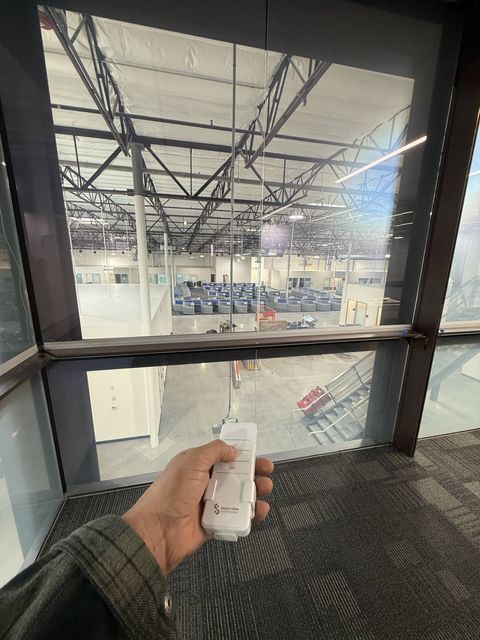
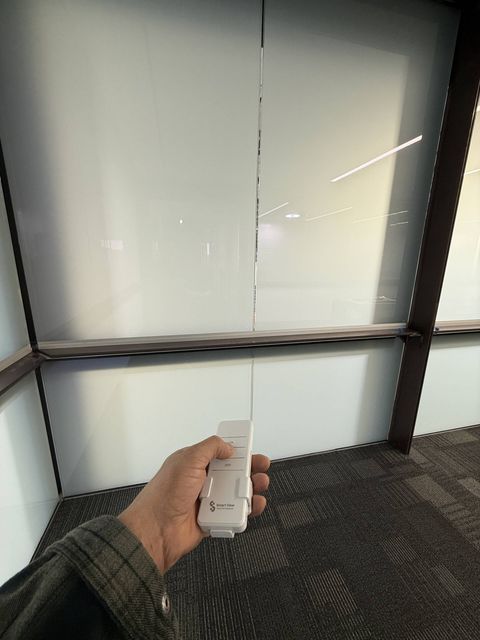
The photos in this post are the glass-walled conference room we upgraded for Upper Deck in Carlsbad. Powered clear, the wall keeps the sightline across the open workspace, and from the carpet line to the ceiling the glass reads as glass — the film is invisible unless you go looking for its edge trim. Frosted, the same panels turn into a bright white wall and the room becomes private without feeling closed in.
The change between those two photos is effectively instant. The whole panel switches at once, in well under a second, with no fade-through, no patchiness, and no flicker between states — one press on the remote, and the wall is simply the other thing.
Questions people ask about the way it looks
Is smart film completely invisible on the glass?
In everyday conditions quality film reads as ordinary glass — visitors usually have to be told it's there. Side by side with a bare pane, or against strong backlight, you can pick out a faint softness; that is the few percent of haze every switchable layer carries.
Does the frosted state make the room dark?
No. The frost is translucent white, so daylight keeps passing through and the room stays bright — it blocks the view, not the light. It is privacy, not blackout: pair it with a shade if you need a fully dark room.
Can anyone see shapes through the frosted film?
Not at any normal distance — no outlines, colors, or movement come through, day or night. Something pressed directly against the glass can register as a vague shadow at most, which is true of any frosted glass, etched or switchable.
How fast is the change between clear and frosted?
Effectively instant. The liquid-crystal layer responds in milliseconds, so the whole panel switches at once — no fade-through, no flicker, and no warm-up, however many times a day it's toggled.
The clearest answer is your own glass: send a couple of photos and rough dimensions, and we will tell you honestly how the film will look on your panes — and what it costs. Request a free estimate or call Smart View Film Solutions at (866) 728-9888, and you'll have real numbers within one to two business days.