
Luxury Smart Glass for Homes: 7 Top Specs (2026)

Luxury residential clients in LA — Beverly Hills, Bel Air, Holmby Hills, Pacific Palisades, Malibu — increasingly screen for connected-home spec across all major systems during purchase due diligence. Switchable glass is now part of the expected stack alongside Lutron, Savant, Crestron, integrated audio, and smart climate. Luxury smart glass for homes at this tier carries spec discipline that distinguishes a high-end install from a generic residential one, and the seven specs below are how that distinction shows up.
This guide walks the seven specs we run on every consult that lands in the LA luxury-residential market. Each comes from real installs we’ve shipped across Beverly Hills, Bel Air, Holmby Hills, Brentwood, and Pacific Palisades in the last 12 months.
Why the Luxury Tier Carries a Different Spec Discipline
Generic residential switchable-glass spec works fine on standard LA homes — wall switch, manufacturer’s app, single-room install. At the $5M+ residential tier, the spec discipline changes: BMS-integrated control across whole-home automation, frameless or curved architectural glass, full smart-home stack interoperability, certified Lutron/Savant/Crestron programming, and warranty terms that match the property’s lifecycle expectations. The seven specs below distinguish the luxury tier from the generic.
The 7 Specs That Define the Luxury Tier
- 1. Frameless or minimal-frame glass spec. Luxury LA residential architecture favors frameless or minimal-frame glass on signature surfaces — front-door sidelights, master-bath enclosures, French doors, floor-to-ceiling living-room windows. These surfaces call for laminated assembly with concealed bus-bar wiring rather than retrofit film with visible edge wiring.
- 2. Whole-home BMS integration via Crestron, Lutron RA3, or Savant. Luxury homes already run whole-home automation; switchable glass integrates as a native scene element rather than a standalone product. Certified integrator programming required — the wiring and scene logic gets coordinated with the home’s existing AV, lighting, and climate control during the build or remodel phase.
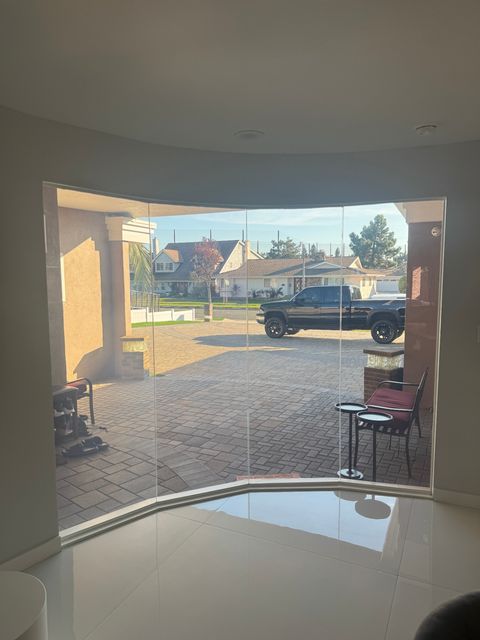
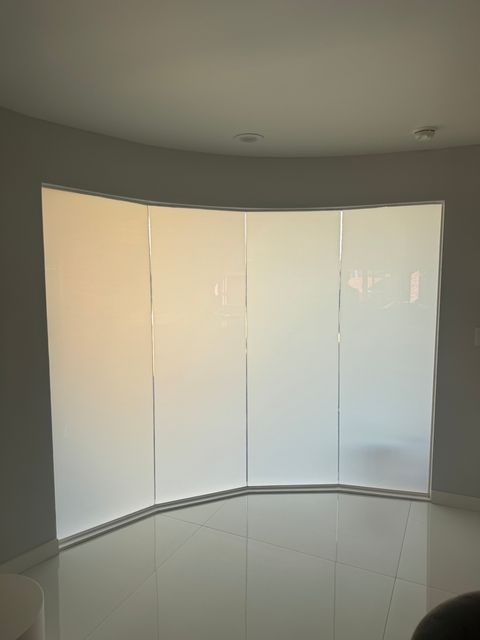
- 3. Curved and shaped-glass spec for signature architectural features. Higher-end LA homes increasingly use curved glass on entry rotundas, atrium walls, master-suite curves, and signature architectural moments. Pre-laminated curved smart glass supports privacy spec on these features without compromising the curve geometry — a retrofit-film approach reads as compromised on these surfaces.
- 4. Master-suite and guest-bath spec across multiple bathrooms. Luxury homes carry 4–8 bathrooms and master suites with switchable glass on the view-facing or shower-enclosure glass. The recurring maintenance load on traditional treatments across that bathroom count becomes meaningful — switchable glass eliminates the line item across the home’s hold period.
- 5. Pool-house, ADU, and detached-structure spec. Luxury LA properties typically include pool houses, accessory dwelling units, guest houses, and detached studios. Switchable glass on the pool-facing or yard-facing surfaces of these structures supports the indoor-outdoor flow that defines luxury LA residential design — open-glass when the property is in entertaining mode, frosted when the structures are in use as guest accommodation.
- 6. Voice and app smart-home control native integration. Voice triggering (Alexa, Google Home, Siri via HomeKit) and smartphone control are table-stakes at this tier. Scenes like “good night,” “movie mode,” and “away” trigger across glass alongside lighting, audio, and climate. Motorized treatments with comparable smart-home integration cost roughly the same as switchable glass and don’t deliver the privacy-on-demand value or architectural-fit benefit. The integration story is a meaningful resale-value contributor at the luxury tier.
- 7. Extended warranty and white-glove service relationship. Luxury clients expect warranty terms that match the property’s lifecycle expectations — 10+ year manufacturer warranty, 5+ year install warranty, named-installer service relationship over the life of the install. Hedging or generic warranty terms is a flag at this tier.
For broader context on what a credible smart glass company looks like at the luxury-residential tier — the team experience, install discipline, and warranty stance that high-end clients increasingly require — see our smart glass company page.
The Performance Numbers Behind the Spec
Underneath the spec discipline, the day-to-day performance of switchable glass is what luxury clients actually live with:
- Privacy switch speed under one second. Switchable smart glass flips from clear to frosted in under a second — wall switch, smartphone, or voice command. The speed delta matters most on bathroom and bedroom glass where privacy is needed in a hurry.
- Daylight retention in privacy mode. Closed blinds block 80–95% of incoming daylight. Switchable glass keeps roughly 60–70% of incoming daylight as soft diffused light in frosted mode — privacy without throwing the room into artificial-lighting reliance.
- 10-year lifespan vs 3–6-year treatment cycles. Quality switchable smart glass carries 10+ year warranted lifespan with no recurring maintenance. Blinds typically need replacement every 3–6 years; curtains every 8–12; frosted vinyl peels at edges within 1–3. Across a 10-year ownership window, the homeowner buys treatments 2–3 times and switchable glass once.
- No dust accumulation, no allergen surface. Blind slats, drape pleats, and mini-blind mechanisms all trap dust and allergens. Switchable smart glass is a flat smooth surface — wipes clean in seconds and disappears from the cleaning rotation, a real lifestyle win across a 4–8 bathroom count.
For technical context on the underlying technology that drives these numbers, see our smart glass PDLC page — it covers the spec details that determine product behavior across residential applications.
Where the Investment Pays Back Most Clearly
Across the LA-area luxury-residential installs we ship, this spec tier earns its cost back fastest on three home types:
- $5M+ Beverly Hills, Bel Air, and Holmby Hills residential. Specs #1 (frameless), #3 (curved), and #6 (smart-home integration) compound — the architectural read of the install reads as native to the property’s spec tier rather than retrofit.
- Modern and contemporary luxury homes with floor-to-ceiling glass. Specs #2 (BMS integration) and #6 (voice/app control) compound — the integration story aligns with the home’s existing connected-home stack.
- Multi-structure luxury properties (main house + pool house + ADU + studio). Spec #5 (pool-house and detached-structure) is decisive — the indoor-outdoor flow that defines these properties depends on switchable spec across the structures.
How These Specs Compound Across a Property
The seven specs above don’t sit in isolation — on a typical $5M+ LA luxury property (main house + pool house + 4–6 bathrooms + multiple living spaces), four to six of them compound across the property. The cabling spec, driver placement, and BMS integration scale cleanly because the underlying control logic is the same — only the per-room context differs. The per-room cost drops as the property-wide install scales.
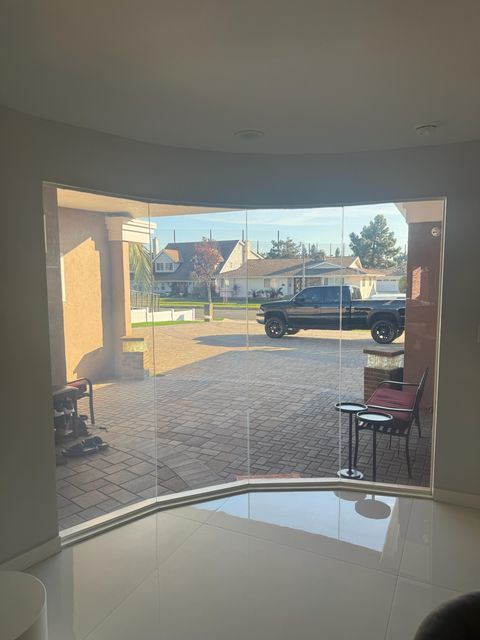
For multi-structure luxury properties, this means a property-wide switchable-glass standard can serve very different surface contexts under one BMS — main-house master bath, pool-house entertaining glass, ADU guest privacy, signature curved entry surfaces — all unified under one Crestron or Savant control system.
The Real Project Math
For a typical $5M+ LA luxury residence with switchable glass across master bath + bedroom + French doors + entry sidelights + pool house (~250 sq ft of glass), spec is quoted in writing after a measurement including BMS integration. For a full whole-property spec covering main house + pool house + ADU (~500 sq ft total), spec is quoted in writing after a measurement.
The resale-value contribution on the LA luxury market typically exceeds the spec cost over the property’s hold horizon — switchable smart glass reads to LA-area buyers as a premium-finish upgrade in the same category as smart thermostats, integrated audio, and concealed wiring, with the resale premium typically running $15,000–40,000 on a $2M–5M property. Luxury buyers in 2026 increasingly screen for connected-home spec, and switchable glass is now part of the expected stack alongside Lutron, Savant, integrated AV, and smart climate.
A Beverly Hills Front-Door Reference
For a concrete example of this spec tier applied end-to-end on a single residential project, our Beverly Hills front-door install hits four of the seven specs directly. Frameless front-door sidelight glass (spec #1), Lutron Caseta integration tied to the home’s existing keypad ecosystem (spec #2), voice triggering via Alexa (spec #6), and full written extended warranty (spec #7) — all designed-in during the project’s design walk rather than retrofit-spec’d.
Full project breakdown: smart glass front door in Beverly Hills — single luxury-residential scope, full spec playbook applied.
Planning a Luxury Residential Smart Glass Install?
If you already have the glass, send a few photos and rough measurements and we can scope most of this remotely before anyone visits. Reach us through the contact page and we will come back with the spec we would recommend and what it would cost.